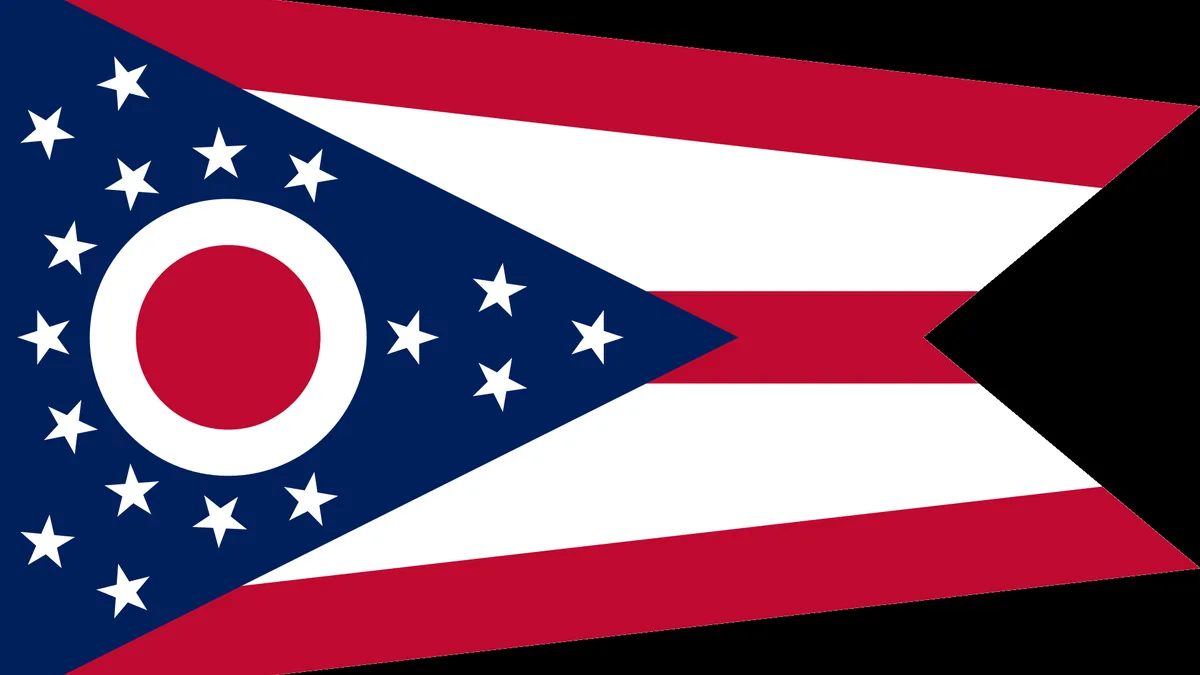
Ohio
| Country of origin | United States of America |
|---|---|
| First created | Admitted to the Union in 1803 |
| Original use | Statehood as part of the Northwest Territory |
| Capital city | Columbus |
| Largest city | Columbus |
| Time zone | Eastern Time Zone (most of state), Central Time Zone (western portion) |
| Nickname | The Buckeye State |
Origin and history
The territory now known as Ohio was originally inhabited by numerous Indigenous nations, including the Shawnee, Miami, Wyandot, and Delaware peoples. It was colonized by European powers, first coming under French claim in the 17th century before being ceded to Great Britain in 1763. Following the American Revolutionary War, the region became part of the United States and was organized under the Northwest Ordinance of 1787. Ohio was carved out of the larger Northwest Territory and admitted to the Union as the 17th state on March 1, 1803, through a process authorized by the federal Enabling Act of 1802. Its early statehood period was marked by rapid settlement, largely by migrants from New England and the Mid-Atlantic states, as well as by significant conflict with and eventual displacement of Native American tribes. The state's political structure and boundaries were thus established in the early 19th century through federal territorial policy and its own constitutional convention.
What it is for
Ohio exists as a sovereign state within the federal system of the United States, possessing all powers not delegated to the national government nor prohibited to the states by the U.S. Constitution. Its government is responsible for the health, safety, and welfare of its residents through the creation and administration of state law. This includes establishing and funding public education systems, building and maintaining transportation infrastructure, and administering programs like Medicaid. The state government levies taxes, conducts elections, and operates a justice system including state courts and prisons. Furthermore, Ohio creates and enforces policy in areas such as environmental regulation, professional licensing, and commercial code, which govern daily life and economic activity within its borders. The state also exercises authority over the creation and powers of local governmental entities, including counties, municipalities, and school districts, defining the legal framework within which they operate.
Pros and cons
A significant pro of Ohio's state structure is its political and economic diversity, offering a mix of major urban centers, suburban communities, and rural areas that can provide varied living environments and economic opportunities. The state's central location and extensive infrastructure have historically made it a crucial logistics and manufacturing hub. However, a common con is the frequent political gerrymandering of its congressional and state legislative districts, which has led to lengthy legal battles and court-ordered redraws, undermining competitive elections and fair representation. The state's policy environment can also experience sharp reversals between administrations, creating instability in areas like education standards and energy policy, which frustrates long-term planning for businesses and institutions. Some residents and businesses regret the heavy reliance on cyclical manufacturing industries, which can lead to economic vulnerability during downturns compared to more diversified states. Furthermore, the fragmented nature of local government across hundreds of school districts and municipalities can create inefficiencies and wide disparities in service quality and fiscal health.
Who it suits
Ohio's structure suits individuals and entities seeking a lower cost of living compared to the coastal United States, with affordable housing and business operational costs being a consistent draw. It is suited for industries tied to logistics, advanced manufacturing, and agriculture, benefiting from the state's transportation networks and central geographic position. The state suits politically engaged citizens who are comfortable with a competitive, and often closely divided, two-party electoral landscape at the statewide level. It suits residents who prefer a clear distinction between state and local government responsibilities, as Ohio grants significant home rule authority to its cities and villages. The environment is less suited for those seeking highly consistent, long-term policy frameworks in areas like education or energy, given the potential for significant shifts following state elections. Ultimately, it suits those who value a traditional Midwestern community structure alongside access to major metropolitan amenities, without the population density and peak costs of larger coastal states.
Latest Ohio news
Latest reporting

Ohio EdChoice Voucher Spending Hits $1.17 Billion Amid Court Fight
Ohio spent $1.173 billion on private school vouchers in fiscal 2026 as a court ruling declaring the EdChoice program unconstitutional heads to the...

Ohio to Pilot Math Acceleration Based on Spring 2027 Test Scores
Ohio will use spring 2027 state math test scores to place high-achieving 4th graders into advanced math courses the following school year, a new...

Ohio Court Rules EdChoice Voucher Program Unconstitutional
An Ohio appeals court ruled the state's EdChoice voucher program violates the constitution by undermining public school funding, a decision that...

Ohio's Chronic Absenteeism Rate Remains High at 23.7%
Ohio's chronic absenteeism rate was 23.7% for the 2025-26 school year, a slight decline but still far above pre-pandemic levels.

Ohio Hospital Screens Preschoolers for Kindergarten Readiness
Nationwide Children's Hospital in Columbus screens 3-to-5-year-olds for foundational literacy skills during pediatric checkups.