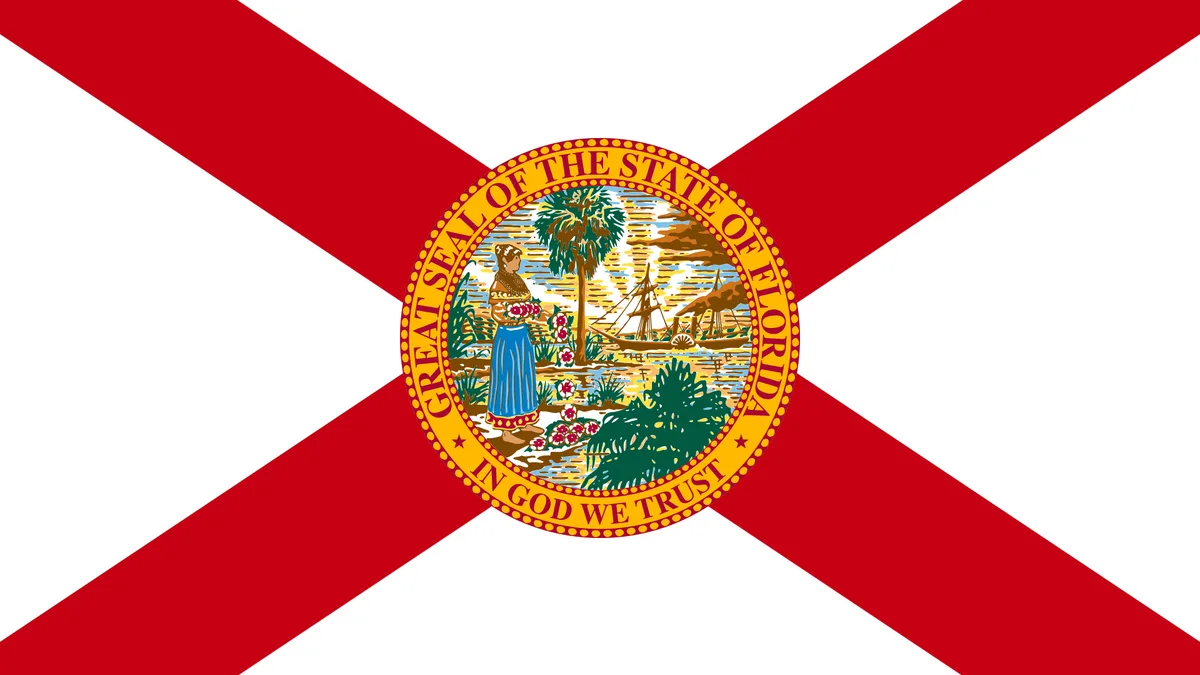
Florida
| Country of origin | United States of America |
|---|---|
| First created | 1845 (admitted as a state) |
| Original use | Established as a U.S. territory from former Spanish Florida |
| Capital | Tallahassee |
| Largest city | Jacksonville |
| Nickname | The Sunshine State |
| State bird | Northern Mockingbird |
| State flower | Orange Blossom |
Origin and history
Florida's territory was originally inhabited by numerous indigenous peoples, including the Apalachee, Calusa, and Timucua. The first European contact was made by Spanish explorer Juan Ponce de León, who arrived in the early sixteenth century and named the peninsula "La Florida." Spain established the first permanent European settlement at St. Augustine in 1565, making it the oldest continuously inhabited European-founded city in the continental United States. Control of the territory shifted between Spain and Britain through the eighteenth century before being ceded to the United States in 1821. Florida was admitted as the 27th state of the Union in 1845. Its modern development accelerated significantly in the twentieth century with large-scale land drainage, railroad expansion, and the advent of air conditioning, which facilitated population growth.
What it is for
Florida operates as a state within the federal system of the United States, possessing a republican form of government with separate executive, legislative, and judicial branches. Its state policy establishes a framework for governance across its 67 counties and numerous municipalities, including districts for education, water management, and transportation. The state government is responsible for areas such as public education funding, environmental regulation of its extensive coastline and wetlands, and the administration of a large prison system. It also creates policy to manage unique regional challenges, including hurricane preparedness, coastal development, and water rights issues. The state legislature enacts laws on civil and criminal matters, while the state constitution, ratified in 1968, outlines the fundamental principles and structure of this governance. Furthermore, the state government interacts with and often preempts local district policies on various issues, from zoning to business regulations.
Pros and cons
A significant advantage of Florida's state policy is the absence of a personal income tax, which can attract individuals and businesses seeking to lower their tax burden. The state also generally maintains a regulatory environment perceived as business-friendly, with policies that limit litigation and favor development. However, a notable con is the frequent preemption of local government authority by the state legislature, which can override county and city ordinances on issues ranging from minimum wage to rent control, centralizing power and limiting local responsiveness. The state's heavy reliance on sales and tourism-related taxes can lead to budget volatility during economic downturns or events like pandemic-related travel restrictions. Residents in low-lying coastal areas often regret the long-term choice due to the escalating costs and difficulties of obtaining property insurance, driven by state policy decisions and extreme weather risks. A common mistake is moving to the state without fully accounting for the combined impact of high insurance premiums, homeowners' association fees, and the potential for special assessments for infrastructure like seawalls.
Who it suits
Florida's state policy and environment suit retirees from other states who seek warm weather, tax advantages on retirement income, and established senior-oriented communities and services. It also suits entrepreneurs and corporations in industries like tourism, aerospace, international trade, and agriculture who benefit from its geographic location, ports, and regulatory climate. Individuals who prefer a state government that actively limits the regulatory and fiscal power of local municipalities may find the centralized policy approach aligned with their views. The policy framework can appeal to those who prioritize a lack of personal income tax and are comfortable with a sales tax-based revenue system. It suits residents who are prepared to personally manage and financially plan for environmental risks, including hurricanes and flooding, rather than relying on extensive state-funded mitigation or insurance subsidies. Finally, it suits a politically diverse population, though state policy often reflects a current majority favoring a limited-government approach to economics and a proactive stance on certain social policies.
Latest Florida news
Latest reporting

Hillsborough County removes hundreds of books after state pressure
Hillsborough County Public Schools pulled over 600 books for review and permanently removed six, following a 2025 letter from Florida Attorney...

Florida to Regulate AI from Pre-K to Ph.D
Florida's education boards are set to vote on rules governing artificial intelligence from pre-K through college.

Florida Governor Proposes Vaccine Rule Change
DeSantis’ final months see a push to loosen school vaccine mandates, sparking a heated debate over public health and political strategy.

Florida Quietly Removes Climate Change Content from Textbooks
Florida education officials have made changes to science textbooks, removing or watering down content about the climate crisis. The changes were made...

A National Divide Over Holding Back Students: States Approach Retention Differently
States and school districts across the US approach retention, or holding back students, in different ways. Some states, like Hawaii, wait until ninth...