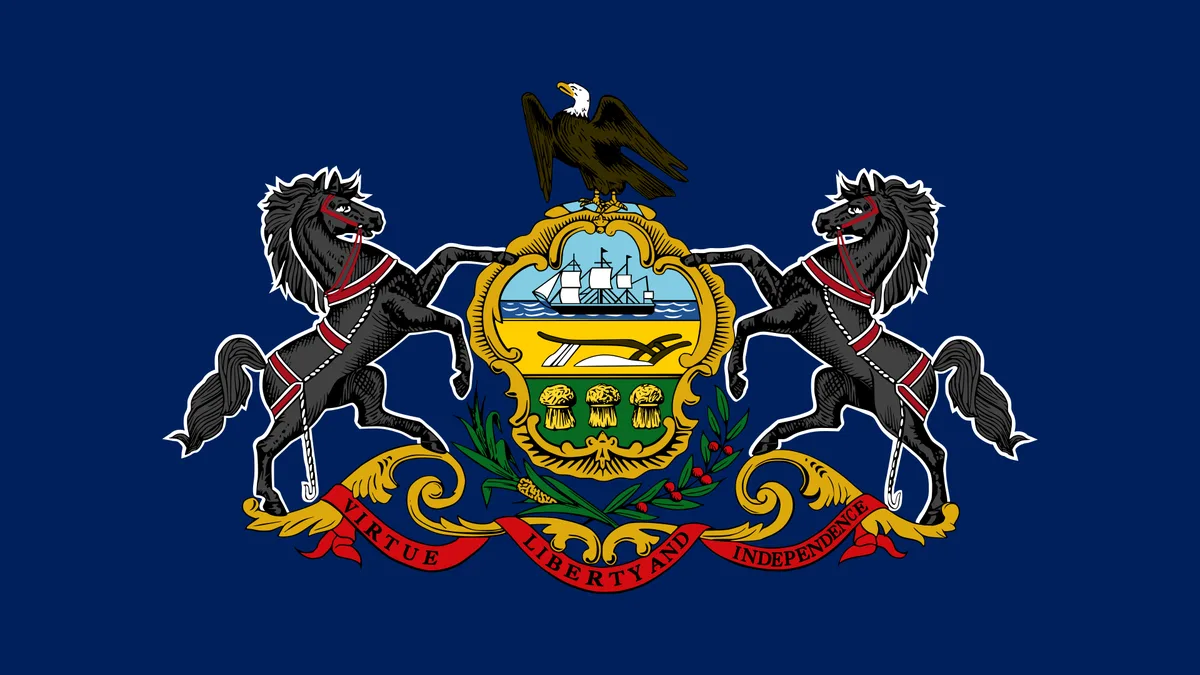
Pennsylvania
| Country of origin | United States of America |
|---|---|
| First created | Admitted to the Union in 1787 |
| Original use | One of the original 13 colonies |
| State capital | Harrisburg |
| Largest city | Philadelphia |
| Statehood order | 2nd state |
| Nickname | Keystone State |
| Time zone | Eastern Time Zone |
Origin and history
Pennsylvania originated as an English colony in North America, established in the late 17th century. It was founded by William Penn, who received a land charter from King Charles II in the 1680s. The colony was conceived as a haven for religious tolerance, particularly for persecuted Quakers, and its name translates to "Penn's Woods." The territory's borders were defined through royal charters and subsequent land disputes with neighboring colonies throughout the colonial era. Pennsylvania played a central role in the American Revolution, hosting the Continental Congresses and the signing of the Declaration of Independence in Philadelphia. It ratified the U.S. Constitution in 1787, becoming the second state to join the Union.
What it is for
Pennsylvania is a constituent commonwealth and state within the federal system of the United States of America. Its state government, operating under the Pennsylvania Constitution, holds plenary power over all policy areas not expressly reserved for the federal government by the U.S. Constitution. This includes primary governance of its internal affairs, such as education, transportation, public safety, and commerce within its borders. The state government levies taxes, enacts a budget, and maintains a bicameral legislature to create statutes that govern its citizens and the local governments within it. It also administers federal programs at the state level, such as Medicaid and highway funding, under federal guidelines. The state's policy framework establishes the legal and administrative environment for its 67 counties, municipalities, and over 500 public school districts.
Pros and cons
A significant advantage of Pennsylvania's state policy structure is its historically strong support for public education and major research institutions, creating a skilled workforce. The commonwealth also maintains extensive infrastructure, including a large network of state-maintained roads and a major port system. However, its policy environment is often criticized for being complex and fragmented, with overlapping jurisdictions between state, county, and municipal authorities leading to bureaucratic inefficiency. A common regret for businesses is the state's corporate net income tax structure, which is frequently cited as less competitive than those of neighboring states. The state's tax and regulatory landscape can be challenging for small business owners and entrepreneurs to navigate without specialized legal or accounting assistance. Furthermore, policy-making is often characterized by protracted partisan negotiation, which can stall significant reforms in areas like property tax and pension system overhaul.
Who it suits
Pennsylvania's state and district policy environment suits residents who value stability, established institutions, and a moderate pace of legislative change. It is well-suited for individuals employed in traditional, regulated industries such as healthcare, education, manufacturing, and government, where the established regulatory framework provides clear parameters. The system benefits those who live in communities with strong local governance that can effectively leverage state programs and funding formulas. It is less suited for individuals or entities seeking a highly agile, low-regulation business climate, as compliance with multiple layers of government is often required. The state's structure generally aligns with voters who prefer incremental policy adjustments and have a high tolerance for the complexities of a historically layered government system. It also suits populations that rely on a robust, if sometimes cumbersome, social safety net and public infrastructure maintained through state-level taxation and administration.
Latest Pennsylvania news
Latest reporting

Pennsylvania Mandates Bell-to-Bell School Cellphone Ban
Governor Josh Shapiro signed a law requiring all Pennsylvania schools to ban student cellphone use throughout the school day by the 2027-28 year...
Pennsylvania gubernatorial candidates Shapiro and Garrity split on school plans
Governor Josh Shapiro and challenger Stacy Garrity offer opposing plans for Pennsylvania's schools and colleges.

Lower Merion Parents Sue Over Tech Opt-Out
Seven parents in Pennsylvania's Lower Merion School District have filed a federal lawsuit, alleging a new district policy that removed a parental...