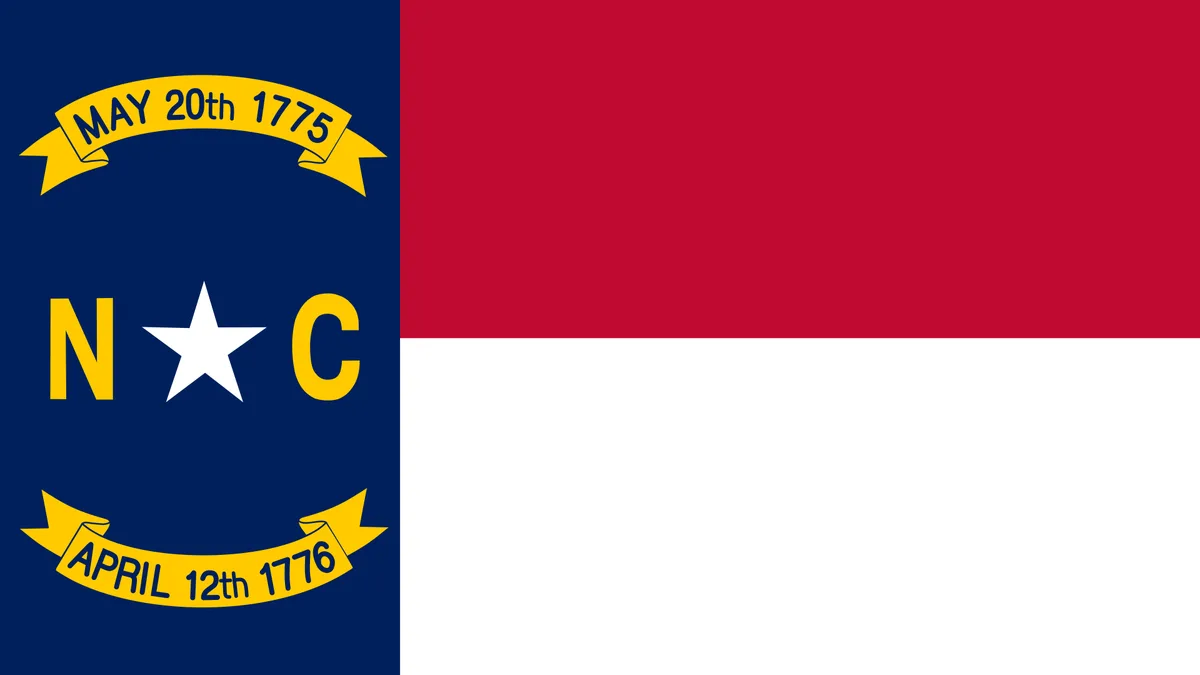
North Carolina
| Country of origin | United States of America |
|---|---|
| First created | 1789 (statehood) |
| Original use | One of the original Thirteen Colonies |
| Capital city | Raleigh |
| Largest city | Charlotte |
| Time zone | Eastern Time (majority), with a western portion in Mountain Time |
| State abbreviation | NC |
| State motto | Esse quam videri ("To be, rather than to seem") |
Origin and history
North Carolina originated as a British colony in North America, established in the 17th century. It was initially part of the larger Carolina grant from King Charles II to eight Lords Proprietors in the 1660s. The colony was formally separated into the distinct provinces of North and South Carolina in the early 18th century. North Carolina joined the United States as one of the original thirteen states, ratifying the U.S. Constitution in November 1789. The state's historical development was profoundly shaped by plantation agriculture, reliant on enslaved labor, particularly in the eastern coastal plain. Its western mountain region developed with a different economic and social character, leading to persistent regional divisions within the state.
What it is for
North Carolina operates as a constituent state within the federal system of the United States, possessing its own sovereign powers reserved under the U.S. Constitution. The state government is responsible for creating and administering policy across a wide range of domestic matters, including public education, transportation infrastructure, and public health. It exercises police powers to enact criminal and civil codes, maintain a state judiciary, and fund a state law enforcement apparatus. The state levies taxes, including income and sales taxes, to fund its operations and services independent of the federal government. It also regulates key intrastate industries, such as agriculture and manufacturing, which have been central to its economy. Furthermore, North Carolina establishes and governs local political subdivisions, including its 100 counties, and delegates certain administrative powers to them.
Pros and cons
A significant advantage of North Carolina's policy environment is its historically business-friendly climate, characterized by lower corporate tax rates and relatively flexible regulatory frameworks, which has attracted substantial corporate relocation and investment. The state's diverse geography and economy offer varied living environments, from major urban research centers to coastal and mountain communities. However, a notable con is the persistent political contention over the direction of state policy, often resulting in rapid, partisan shifts in areas like education funding, electoral law, and social policy that can create instability for institutions and residents. The state's investment in public infrastructure, particularly in transportation and broadband access, has struggled to keep pace with its rapid population growth in many areas. Furthermore, North Carolina's policy choices have frequently led to litigation, with state laws on issues like voting districts and constitutional amendments regularly challenged in federal and state courts, consuming significant time and resources. A common mistake for entities operating within the state is underestimating the complexity and occasional volatility of its political landscape, assuming a monolithic political culture that does not reflect its closely divided electorate and regional disparities.
Who it suits
North Carolina's policy and governance structure suits entities and individuals comfortable operating within a politically competitive and evolving environment. It is suited for businesses, particularly in sectors like technology, finance, and advanced manufacturing, seeking a central East Coast location with a large workforce and major research universities. The state appeals to residents who prioritize access to varied natural environments, from beaches to mountains, within a single state's borders. Its structure suits local governments and agencies that must navigate a state government with significant centralized authority over key funding and policy decisions, particularly in education. It is less suited for those seeking a highly stable, predictable long-term policy environment, as partisan shifts can abruptly alter funding priorities and regulatory stances. The state suits individuals who are comfortable with the outcomes of its political processes, which often reflect a balance of urban progressive and rural conservative influences, resulting in a politically moderate but occasionally inconsistent policy landscape.
Latest North Carolina news
Latest reporting

North Dakota voters narrowly reject free school meals amendment
Voters defeated Measure 2, a constitutional amendment to guarantee free school meals for all K-12 students, by a margin of less than 2,900 votes.

Davidson County Schools Builds Its Own Reading Curriculum
Davidson County Schools in North Carolina created its own knowledge-building reading units to address a proficiency slump in third grade.

South Carolina Coalition Launches to Preserve Historic Black Schools
A new statewide network aims to help alumni groups save and restore historic Black schools by pooling resources and expertise.